
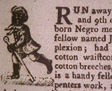








Virginia Gazette (Purdie & Dixon), Williamsburg, December 23, 1773.
Mr. PURDIE,
By giving the enclosed a Place in your Gazette you will oblige a Customer, and a Friend. Should it be the Cause of alleviating the Torments of some of our Fellow Creatures, by putting a Stop to the Practices of a cruel and savage Master, it will fully compensate me for the small Trouble I have been at in writing, and you, I make no Doubt, for publishing it. LUCIUS.
A CIRCUMSTANCE hath happened, which makes it necessary that the Eyes of the Publick should be, for once, turned upon the Conduct of a certain R. M. of A----a; who, it is said, has been, for several Years, wantonly, cruelly, and inhumanly, imbruing his Hands in the Blood of his miserable Slaves, and is still suffered to add Crime to Crime with Impunity. Some Time last Summer, a Negro Woman of his, not able any longer to stand the Scourge, which was daily inflicted upon her, contrived to make her Escape, and took Refuge in the Quarter of a Gentleman, who declared to me that the Abuse she had received far exceeded any Thing of the Kind he had ever seen, and that, although he was forced to send her off his Plantations, he could not find in his Heart to send her back to her barbarous Master. The poor unhappy Creature was soon after taken up, and carried home; and, lacerated as she was, the inhuman Monster, not fully satiated with the Blood of her Brethren, tied her up and tortured her to Death. This is but one of the many Crimes this Tyrant has been guilty of; the following instance is, if possible, of a deeper Dye, and marks the unrelenting Spirit of the savage Monster. Poor Hampsin, after undergoing the Lash repeatedly, had his Ears cut off, both his Legs, and underwent Castration; and, mutilated as he was, his Master still continued to abuse him so inhumanely that he was at last obliged to contrive Means for his Escape, and in that mutilated Condition, collecting Strength from Fear, he reached the Distance of between fifty and sixty Miles from home, but was taken up and committed to Charlotte County Jail. There he cried out, that rather than he be carried back he would choose to die; and that the only Alternative left him was to perish by his Master's Hand, or be his own Executioner. He chose the latter; for the first Night of his Confinement he set Fire to the Prison, and perished in the Flames. Can the Annals of ancient or modern Times produce two Instances more replete with Barbarity? No, surely; very few, I believe, can be found equal to such horrid and infernal Practices. Were a Stranger to come here, and be told that the Perpetrator of such Deeds remains unpunished, would he not suppose that there did not exist a Law for bringing the Murderer to Justice? But it is well known that our Legislature have provided in such Cases, making the wilful Murder of Negroes a capital Crime, and Blood to go for Blood. Some People say (and very justly too, I think) that the Gentlemen of A----a are quite inexcusable for not taking Cognizance of such Matters; that they appear destitute of Humanity, as well as neglectful of their Duty, or they would not have suffered the Blood of so many friendless Creatures to cry in vain for Protection. The Law points out a Mode of Information to the Coroner, or one of the Magistrates of the County; but perhaps no such Notice has been given, and they wait for it. They must know, however (or at least ought) that if there be Cause to suspect any Person, white or black, to be murdered in their County, it is the Business and Duty of the Coroner, or any of the Magistrates who may receive Information, to summon a Jury and view the Body; and if they had but acted in that Manner when R.M. buried a Negro, I am persuaded Marks of Violence would have been found. For it is strange, passing strange: that upwards of fifty Slaves should all die, on one Plantation, of natural Deaths, in the space of fifteen or twenty Years, and in so healthy a Part of the Country too. This Circumstance, joined to many others, equally pregnant with Truth, would, I should think, be sufficient to induce any Officer, who possessed the least Spark of Benevolence or Pity, to issue his Warrant, and proceed as agreeable to his Duty; and although the Proof might not be sufficient to bring the guilty Person to that Punishment he has long since deserved, it might be productive of one good Effect, that of deterring him from committing any more such Cruelties, and relieving, in some Degree, the unhappy few [illeg.] that remain his Property.
Although the said R.M. has hitherto eluded the Force of the Laws, he has not been able to escape the all-seeing Eye of that kind Being who is a Friend to the Friendless, and who, it would seem, has already begun to reward him for all his Misdeeds. For, let it be remembered, that although this Man was born to an affluent Fortune, Poverty now stares him in the Face, and his Situation is not far from Beggary, with a Number of heavy Debts hanging over his Head, ready to plunge him into that Obscurity where happy it would have been for the Race of Cain had he been originally placed. But, alas I this Circumstance, grating as it is, only forebodes those Torments and Misery that await him, and which, for his unparalleled Barbarity, he is doomed to suffer, when Time shall be no more.
Bibliographic Information
Virginia Gazette (Purdie & Dixon), Williamsburg, December 23, 1773.
Availability
Available to the general public at URL: /gos/
Text and images © copyright 2003, by the Rector and Visitors of the University of Virginia